

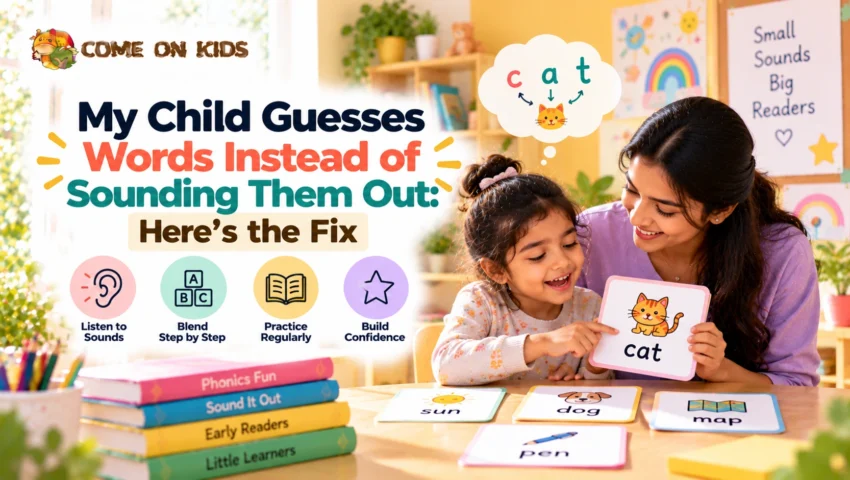
Your child looks at the word “dog” and says “cat.” Not because the letters look alike, but because there’s a dog in the picture and that’s what they expect to see. A page later, they do the same thing with a completely different word. If this sounds familiar, you’re watching a very common reading habit called guessing, and it has a fairly simple fix once you know what to practise.
Why Children Guess Instead of Sound Out Words
Many early readers start out by memorising the shape of a whole word, or by using the picture on the page as a shortcut, rather than working through the letters one sound at a time. This works fine on simple, repetitive books that a child has heard many times. It starts to fall apart the moment the text is new, the picture is missing, or the word is one they haven’t seen before.
Phonics practice ties specific sounds to specific letters and letter groups, so a child can work out almost any word on the page, not only the ones they have already memorised. Guessing isn’t a sign that something is wrong with your child. It’s usually a sign that decoding hasn’t become the first habit yet, and picture or pattern guessing has filled the gap instead.
Guessing vs Decoding, Side by Side
| Situation | A Guessing Reader | A Decoding Reader |
|---|---|---|
| Sees a brand new word | Glances at the first letter and the picture, then guesses | Sounds out each part of the word before saying it |
| Makes a mistake | Rarely goes back to check | Often pauses and self-corrects after re-reading |
| Reads a page with no picture | Struggles much more than usual | Manages close to their usual level |
| Meets a long or unfamiliar word | Skips it, or swaps in a shorter word | Breaks it into smaller sound chunks |
If you recognise your child mostly in the middle column, that’s useful information, not a reason to worry. It simply tells you where to start practising.
A Simple At-Home Blend-and-Check Routine (10 Minutes a Day)
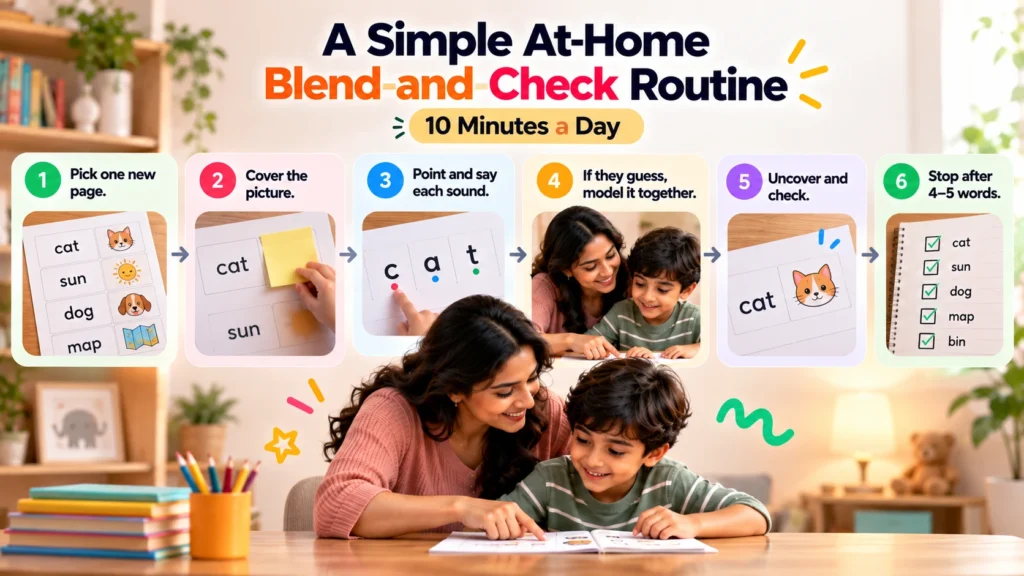
You don’t need a classroom or a curriculum to start building the decoding habit. A short, calm routine most evenings works better than one long session on a Sunday.
- Pick one page your child hasn’t seen before, not a memorised favourite.
- Cover the picture with a finger or a sticky note for the first read.
- Ask your child to point under each letter chunk and say the sound before saying the whole word out loud.
- If they guess instead, stay calm and say “let’s sound that one out together,” then model it once yourself.
- Uncover the picture and let your child check whether their decoded word actually matches.
- Stop after 4 to 5 words. A short, successful practice beats a long, frustrating one.
Keep a light touch. The goal of this routine is to make sounding-out the automatic first move, not to catch every guess as a mistake.
Want to see what a day’s practice actually looks like before you start at home? Take a look at the Daily Phonics Worksheets for Kids to see a sample page level by level.
Want to see a sample page before you start at home? Ask ComeOnKid for a free sample page on WhatsApp at +91 90255 08131 before you decide whether this routine and these worksheets are the right fit for your child.
How ComeOnKid’s Phonics Levels Match Each Stage
The Daily Phonics Worksheets for Kids are built around three levels, and matching your child to the right one makes the blend-and-check routine above much easier to run.
| Level | Focus | Good fit for |
|---|---|---|
| Level 1, Little Sounds | Single letter sounds and matching a sound to its letter | A child who is just starting to notice that letters have sounds |
| Level 2, Blend & Build | Blending two or three sounds into short words | A child who knows individual letter sounds but still guesses whole words |
| Level 3, Sound Detectives | Longer words and trickier letter patterns | A child who decodes short words confidently but freezes on longer ones |
Each level arrives as one printable workbook on WhatsApp, Monday to Friday, with eight activity pages, a parent answer key, and an achievement certificate once a level is complete. The plan currently costs around ₹500 a month, with monthly and yearly options ranging from ₹499 to ₹4,999, and it’s built for roughly ages 4 to 8. Sample worksheets for each level are shared through a Google Drive link, so you can see exactly what arrives before paying for anything.
Not sure which level to start at? Message ComeOnKid on WhatsApp at +91 90255 08131 with your child’s age and a quick example of what they do when they meet a new word, and we’ll help you pick the right level to start at.
Is This Just a Phase, or Does It Need Extra Attention?
Guessing at words is a normal part of learning to read for most young children, especially between roughly ages 4 and 7, while decoding is still a new skill rather than a habit. It’s worth paying closer attention, and talking to your child’s teacher, if the guessing habit continues heavily well past this stage, if your child avoids reading aloud altogether, or if a teacher has already raised a concern. A short home routine is a helpful supplement to classroom teaching, not a replacement for it, and it isn’t meant to replace a professional assessment if one has been suggested.
Once decoding becomes automatic, many parents move on to the Daily English Worksheets for Kids, which build on solid reading with grammar, vocabulary, and comprehension practice from Grade 1 onward.
Frequently Asked Questions
The Bottom Line
A child who guesses at words isn’t behind, they just haven’t made sounding-out the automatic first move yet. A short daily routine, matched to the right starting level, usually closes that gap faster than most parents expect, and it’s a habit that keeps paying off well beyond the early reading years.
If you’d like to talk this through in person, or see how Worksheets fit alongside our play school and day care programmes, visit the Enrol page.
Want to see what your child would be practising? Start a conversation with ComeOnKid on WhatsApp at +91 90255 08131 and we’ll send a free sample page from Level 1 or Level 2 so you can see exactly what your child would be practising with, before you commit to a plan.