

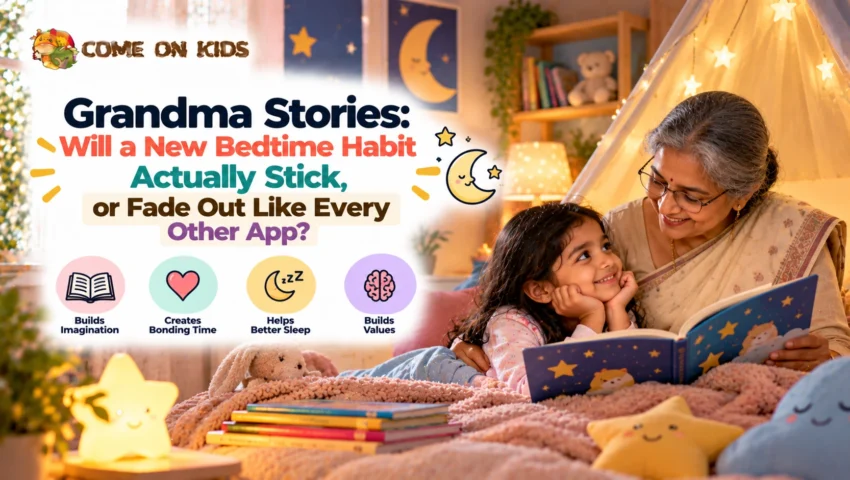
Most homes already own something that was bought with real excitement for a child and then quietly stopped getting used within a month: a reading app with a login nobody remembers, a fitness tracker still sitting in its box, a worksheet pack half finished on a shelf. The pattern is almost always the same. The thing needed a parent to actively remember it, open a separate screen, choose something inside it, and hand it over, and on the one evening that step got skipped, skipping it again the next evening became noticeably easier. ComeOnKid’s Grandma Stories was built around one specific decision meant to avoid exactly that failure point: the story does not sit inside a separate app a parent has to go find. It lands directly inside WhatsApp, an app that is already opened every single day for reasons that have nothing to do with parenting at all.
That does not automatically make a bedtime story habit stick in every house, and it would not be honest to promise that it does. What it removes is the specific decision point where most new parenting routines quietly die. That is worth looking at directly, with real detail, before deciding whether Grandma Stories is likely to become a genuine five-day-a-week habit in your own home, or just one more thing tried for a week and then forgotten.
Why a New Parenting Routine Usually Dies Within the First Two Weeks
A bedtime routine rarely fails because a parent stops caring about it. It fails because it depends on a step that only happens if someone actively remembers to take it each evening: opening a separate app, scrolling to find something age appropriate, deciding whether tonight’s content is actually any good, and then doing all of that again tomorrow night. Any single tired evening is enough to skip that step once. Skipping it once makes skipping it a second time noticeably easier, and by the third or fourth missed evening the habit has quietly ended without anyone ever deciding to end it on purpose.
This is not unique to bedtime stories. It is the same reason a fitness app loses most of its users within the first month, the same reason a language-learning streak quietly breaks, and the same reason a worksheet subscription stops getting opened once the first busy week hits. The content inside each of these things might be genuinely good. The habit still collapses because the delivery depends on a parent’s memory and energy at the exact moment they have the least of both.
| Why a Habit Usually Breaks Down | How Daily WhatsApp Delivery From Grandma Stories Avoids It |
|---|---|
| Forgetting to open a separate app that evening | The story arrives inside WhatsApp, which gets checked anyway, so there is nothing extra to remember to open |
| Having to choose new content from a library every single night | One new story is sent Monday through Friday; there is nothing to browse or decide between |
| A child losing interest once the same handful of stories repeat | The content itself changes each weekday rather than looping through a fixed set |
| A tired parent with no energy left to pick or prepare anything | The story is already written and ready before it ever reaches the phone |
| A missed day feeling like it “breaks” the routine entirely | Stories keep arriving on schedule regardless of whether yesterday’s was heard |
Want to judge this for yourself rather than take it on faith? ComeOnKid keeps sample stories in a shared Google Drive folder. Message ComeOnKid on WhatsApp at +91 90255 08131 and ask to hear one before paying for anything.
What Actually Decides Whether a Story Habit Sticks in Your Particular House
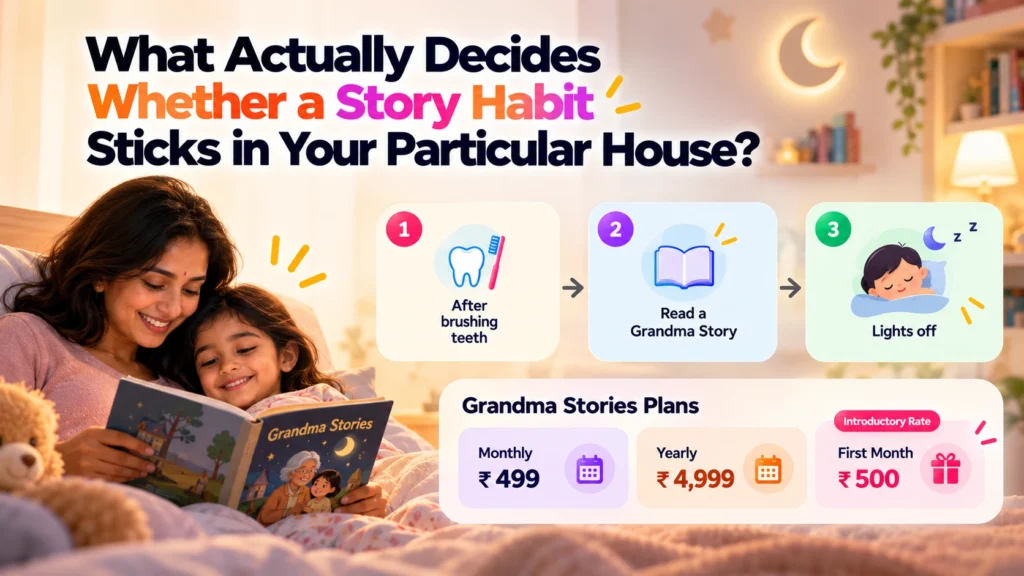
Removing the friction of opening and choosing content solves one part of the problem, but the rest depends entirely on where the story sits inside an evening that already has its own shape. A story that arrives at a random time and gets read “whenever there’s a minute” is competing with everything else happening in the house at that exact moment, and it usually loses. A story attached to a fixed point that already exists every single weekday, such as the few minutes right after brushing teeth and right before the light goes off, tends to survive, because it is riding on a habit that was already going to happen anyway, rather than asking a parent to build a brand new one from nothing.
Grandma Stories plans currently run from ₹499 to ₹4,999 across monthly and yearly options, with an introductory rate of ₹500 for the first month. That price range is deliberately low enough that testing whether the habit actually survives past two weeks costs less than most single toys do, which matters, because the honest answer to “will this stick” is that no one can promise it in advance for your specific family. A short, cheap trial is a far more useful answer than a guarantee would be.
Want to test whether the habit survives two weeks? Message ComeOnKid on WhatsApp at +91 90255 08131 to start at this month’s introductory rate before deciding on a longer plan.
What a Realistic Two-Week Trial Actually Looks Like
It helps to picture the first two weeks concretely instead of treating “will it stick” as an abstract question. In a typical first week, the story arrives on WhatsApp sometime during the day, and the parent decides where it fits that evening, usually right before or right after an existing routine like teeth-brushing or changing into pyjamas. The first two or three days usually go smoothly simply because the idea is new and a little exciting for the child. The real test comes around day four or five, on the first genuinely busy or tired evening, which is exactly the moment most routines quietly slip in any household.
What tends to separate a family where this sticks from one where it fades is not willpower. It is whether the story got attached to something that was already happening every day regardless of how the parent felt that evening. A family that treats the story as “one more task to remember” alongside dinner, bath, and homework usually drops it the first time the evening runs late. A family that treats it as “the thing that happens the moment pyjamas go on” tends to keep going, because the pyjamas were happening anyway. By the end of two weeks, a parent usually has a clear, honest answer either way, and at this subscription’s price point, that answer costs very little to find out.
What Grandma Stories Is Not a Good Fit For
It is worth being direct about where this does not fit well, since an honest answer here is more useful than a purely promotional one. A child who strongly prefers choosing their own story each night, rather than receiving one chosen for them, may resist a fixed daily delivery at first. A household where WhatsApp itself is not used daily loses the main advantage this subscription is built around, since the whole point is piggybacking on an app already opened for other reasons. And a family hoping for a single guaranteed fix for bedtime resistance in general should know that a story habit addresses one part of a bedtime routine, not every challenge that can show up at bedtime.
Where it tends to fit well is almost the mirror image of that: a household that already opens WhatsApp daily without fail, a child who enjoys being read to rather than insisting on choosing the story every time, and a parent who is looking less for a dramatic fix and more for one small, low-effort addition to an evening that already has some shape to it.
How This Compares to the Other Things Parents Usually Try First
Most families reach for a bedtime story habit only after trying a few other things first, so it helps to place Grandma Stories next to those options honestly. A physical storybook collection works well for families who already have a strong reading habit, but it depends on someone restocking new titles regularly, which is its own ongoing task rather than a solved problem. A general-purpose reading or story app usually has a much larger content library, but that size cuts both ways: more choice can mean more time spent deciding each night instead of less, and the app itself is a separate thing to remember to open, the exact friction point described earlier. Simply narrating a story from memory works for some parents some nights, but it depends on energy and invention that is genuinely in short supply after a long day, which is often the original reason a family starts looking for help with this in the first place.
Grandma Stories does not claim to replace a real storybook collection or a parent’s own storytelling on the nights they have the energy for it. What it offers is a low-effort floor: on the nights nothing else is going to happen, there is still one new story waiting inside an app the family already opens, in a language the family actually speaks at home. For many households the real value shows up not on the easy nights, when almost anything would have worked anyway, but on the harder ones, when the only realistic choice is between this and nothing at all.
Frequently Asked Questions
Conclusion
Nothing about a subscription can guarantee that a family will still be using it a month from now, and any claim promising otherwise would not be honest. What can be said plainly is that most new parenting routines fail at the exact point where someone has to remember to open something separate and choose what goes inside it, and Grandma Stories was specifically built to remove that one step by landing inside an app already opened every day. Whether the habit lasts after that comes down to where it sits inside an evening that already has its own rhythm, and a two-week trial at this price is a cheap, honest way to find out rather than guessing.
See the current plan range and full language list on ComeOnKid’s own Grandma Stories product page.
For a one-time story built around a single occasion instead of a daily habit, ComeOnKid’s Personalized Story Book is worth a look.
Browse everything else ComeOnKid offers for families on the Enrol page.
If every other bedtime habit you have tried has quietly faded within a couple of weeks, give this a genuine two week trial. Message ComeOnKid on WhatsApp at +91 90255 08131 with your family’s preferred regional language and start this month’s introductory ₹500 Grandma Stories plan.