

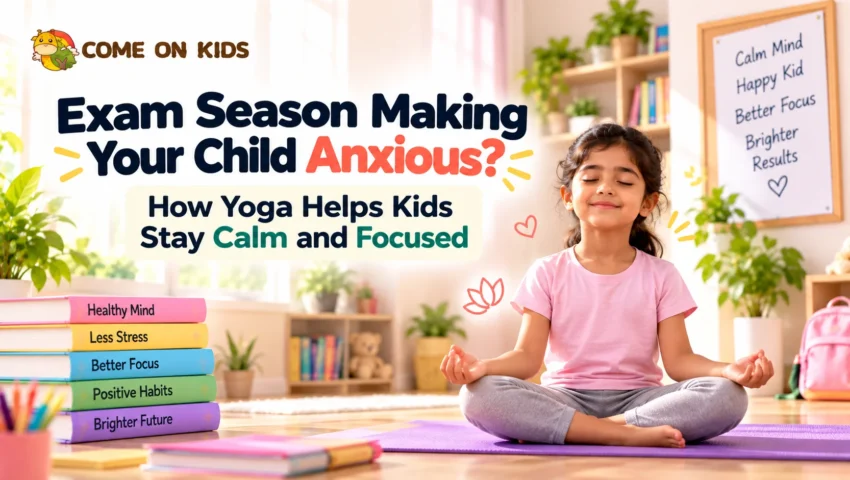
Why Exam Season Hits Some Kids Harder Than Others
Every child responds to exams differently. Some barely notice the change in routine. Others feel it in very physical ways: trouble falling asleep, a racing mind at bedtime, snapping at siblings, or losing focus halfway through a worksheet they would normally finish easily.
There’s nothing wrong with your child for feeling this way. A certain amount of nervous energy before exams is completely normal, and organizations like the CBSE and NCERT have long encouraged schools to keep exam periods stress-aware rather than pressure-heavy, recognising that a child’s mental state directly affects how well they can actually recall and apply what they have learned. The practical challenge for parents is finding something that helps in the 45 minutes before dinner, not just good advice for exam season in general.
What a Kids' Yoga Class Is Actually Trying to Do
ComeOnKid’s Yoga Class is built around Hatha and kids’ yoga styles that blend simple poses with games, storytelling, music, and props, welcoming children aged 5 to 15 at both the Nagamalai centre and the Ponmeni activity centre. It is not a scaled-down adult yoga class. The pace, language, and structure are built for children, with experienced instructors trained specifically to work with kids, personalised sessions where needed, and small, interactive class sizes so no child gets lost in the group.
The benefits parents usually notice first are the physical ones: better flexibility and strength, and a general sense of your child having somewhere to put their extra energy. The ones that matter most during exam season are quieter: reduced anxiety and stress, better self-esteem, sharper focus and concentration, and stronger emotional regulation, meaning fewer meltdowns over a tricky maths problem.
If your child could use a calmer start to this exam season, ComeOnKid’s Yoga Class is open for enrolment for ages 5 to 15 at both centres. Message us on WhatsApp at +91 90255 08131 to ask about current batch timings.
Simple Breathing and Stretching Techniques to Try at Home Tonight
You do not need a yoga mat or a class booking to start helping tonight. These are gentle enough to do in a bedroom or living room, and most take under five minutes.
| Technique | How to Guide Your Child Through It | Best Used |
|---|---|---|
| Balloon Breathing | Ask your child to breathe in slowly through the nose as if filling a balloon in their belly, then breathe out slowly through the mouth. Repeat 5 to 8 times. | Right before starting homework or revision |
| Bee Breath (Humming Exhale) | Breathe in normally, then exhale slowly while making a soft humming sound, like a bee. Repeat 4 to 5 times. | When a child is visibly frustrated or on edge |
| Child's Pose Stretch | Kneel, sit back on the heels, and stretch the arms forward on the floor, resting the forehead down. Hold for 20 to 30 seconds. | After long stretches of sitting still to study |
| Legs-Up-the-Wall | Lie on the back with legs resting up against a wall for a few minutes, breathing normally. | Just before bedtime during exam week |
A few things make these more likely to actually work. Do them together rather than instructing from across the room, since kids tend to follow a calm adult more than a calm instruction. Keep sessions short, two to five minutes is plenty for most children. And try to use them consistently at the same point in the evening, so the technique becomes a signal to the body that it is time to settle down, not just a random exercise.
For Younger Children (Ages 5 to 8)
Frame these as a game rather than an exercise. “Let’s breathe like we’re blowing up a balloon” works far better than “let’s do a breathing exercise.” Storytelling helps too: imagining floating on a cloud during Legs-Up-the-Wall keeps a younger child engaged for the full few minutes.
For Older Children (Ages 9 to 15)
Older kids often respond well to understanding the why behind it, a short, honest explanation that slow breathing calms the nervous system and can make it easier to think clearly can go further than a game framing at this age. Some pre-teens and teens also prefer a few minutes of quiet stretching alone in their room over a shared family activity, and that is worth respecting.
Building a Calmer Evening Routine During Exam Weeks
A single breathing exercise helps in the moment. A routine helps for the whole exam period. Here is a simple structure many parents find workable:
- Set a fixed study window rather than an open-ended one. Knowing revision ends at a specific time reduces the dread of it feeling endless.
- Add a five-minute movement break halfway through, a stretch, a short walk around the house, or a couple of yoga poses, before returning to books.
- Protect the last 30 minutes before bed as screen-free and book-free. This is where breathing exercises or gentle stretches fit naturally.
- Keep meals and sleep times steady. Exam weeks are exactly when routines tend to slip, and that is when children need them most.
- Say something reassuring out loud, even briefly. A simple “I know this is a lot right now, and I’m proud of how you’re handling it” does more for a stressed child than another reminder about the syllabus.
Normal Exam Nerves Versus When to Get Extra Support
Most exam-time stress in children is temporary and eases once the exams end. Some restlessness, a bit of moodiness, and a few off nights of sleep fall well within the range of normal.
It is worth talking to your child’s class teacher, school counselor, or paediatrician if the anxiety seems to go well beyond exam nerves, for example if it is affecting appetite or sleep for weeks at a stretch, or showing up outside of exam time too. Yoga and breathing techniques are genuinely useful tools for everyday stress, but they are not a substitute for professional support when a child needs it.
Where Yoga Fits Alongside Everything Else Your Child Is Doing
Yoga works best as one part of a broader routine rather than a stand-alone fix. Pairing a weekly Yoga Class with other screen-free downtime, such as Daily Kids Activities at Home, gives children a genuine break from academic pressure rather than trading one structured activity for another. For families juggling after-school hours, Evening Day Care also builds in supervised play and a steady routine, which does a lot of the same quiet, stress-reducing work in the background.
Prefer having a trained instructor guide these techniques rather than figuring it out from a blog post alone?
Reach out on WhatsApp at +91 90255 08131 and we can help you find a Yoga Class batch that fits around your child’s exam schedule.
FAQ
The class welcomes children aged 5 to 15, with instructors trained to adjust pacing and instruction for different age groups.
Most parents find the opposite happens. A weekly class and a few minutes of breathing practice at home tend to make study sessions more productive, since a calmer child concentrates better than an exhausted, wound-up one.
The class combines physical poses with breathing techniques and mindfulness elements, and its listed benefits specifically include reduced anxiety and stress, better focus and concentration, and stronger emotional regulation, not just flexibility.
No prior experience is expected. Classes are built around simple poses, games, storytelling, and music, and are designed for beginners.
No. They are helpful everyday tools, but if anxiety seems to go beyond normal exam nerves, it is worth speaking with your child’s teacher, school counselor, or paediatrician.
Classes run at both the Nagamalai centre and the Ponmeni activity centre in Madurai.
No, it runs as a regular weekly course. Exam season is simply when its calming and focus-building benefits tend to matter most to parents.
A calmer exam season rarely starts with a big change. It usually starts with one small habit repeated consistently, whether that is five minutes of breathing before bed or a weekly yoga class your child actually looks forward to. If you would like your child to have both, visit the Enrol page to sign up for Yoga Class, or send us a WhatsApp message at +91 90255 08131 if you have questions first.