

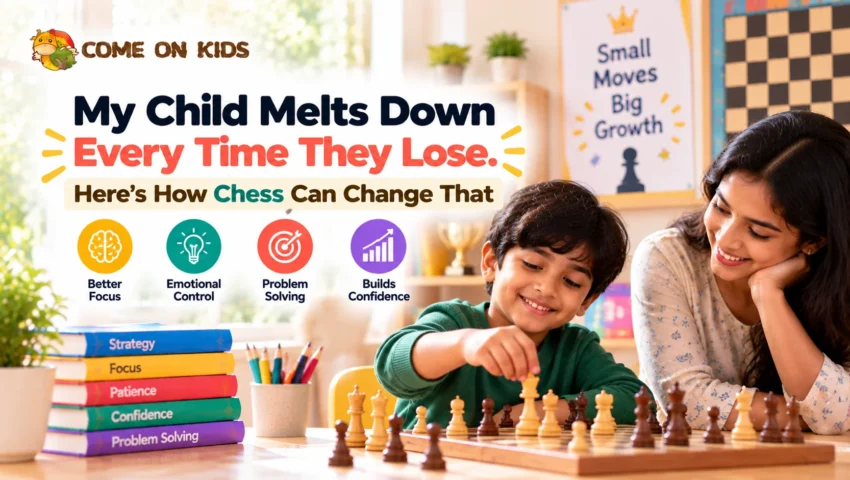
benefits of chess for children's emotional resilience, chess and frustration tolerance in children, chess class benefits beyond winning, chess classes for kids in Madurai, extracurricular activities that build patience in kids, helping a child who hates losing, how to teach a child to lose gracefully, strategic thinking games for kids
A missed goal in a football match, a board game that does not go their way, a round of snakes and ladders lost to a younger sibling, and suddenly your child is in tears, pushing pieces off the table, or refusing to play again. If this sounds familiar, you are not raising a sore loser. You are raising a child who has not yet had enough safe, low-pressure practice at losing. Chess, it turns out, is one of the gentlest places to get that practice.
Why Losing Feels So Big for Young Children
Young children are still building the emotional vocabulary and self-control to separate “I lost this game” from “I am not good at this.” That gap is a well-documented, completely normal part of early childhood development, even when the tears in the moment feel enormous to a parent watching. The skill involved, often called frustration tolerance, is not something a child either has or lacks for life. It is something built gradually, through repeated, low-stakes practice, and that is exactly where an activity like chess can help.
What Makes Chess a Useful Place to Practice This
Chess has a few structural features that make it a particularly good training ground for handling a loss. There is no teammate to share the blame with, no luck of a dice roll to point to, and a visible board that shows exactly which decisions led to the outcome. A child cannot say the game was unfair. They can only look at the board and ask what happened, which is precisely the habit parents are usually hoping to build.
| Skill | What It Looks Like on the Chessboard | Where Parents Usually Notice It at Home |
|---|---|---|
| Patience | Thinking through a move instead of grabbing the first piece they see | Waiting their turn in conversation or in a queue |
| Accepting a setback | Losing a piece, or the whole game, and sitting down for the next one anyway | Trying again after getting a homework answer wrong |
| Taking responsibility | Reviewing their own game to see where it went wrong, rather than blaming the opponent | Owning a mistake instead of blaming a sibling or classmate |
| Staying calm under pressure | Thinking clearly in a tense position instead of rushing a move | Staying steady through a difficult exam question or an awkward moment |
How ComeOnKid’s Chess Classes Build This In, Not Just Teach the Rules
ComeOnKid’s Chess Class is open to children ages 5 to 15, with a curriculum designed by chess coaches and instruction personalized from complete beginners through more advanced players. Because classes are small and level-appropriate, a child does not spend weeks being outplayed by someone far ahead of them. They play opponents closer to their own stage, lose at a pace they can actually process, and get guided help noticing what to try differently next time, alongside the concentration, strategic thinking, and patience the class is built to develop.
Want to see what a typical session looks like before enrolling? Message ComeOnKid on WhatsApp at +91 90255 08131 and we can walk you through how a class runs for your child’s age group.
Losing at Chess Compared to Losing Elsewhere
Not every loss teaches the same lesson. A loss in a fast-paced video game or a lucky-draw board game often passes by too quickly, or too randomly, for a child to learn much from it. Chess tends to work differently.
| Where the Loss Happens | What Usually Happens in the Moment | What Chess Does Differently |
|---|---|---|
| A fast-paced video game | The next round starts in seconds, leaving little time to reflect on why they lost | The board stays in front of them, showing exactly where the game turned |
| A team sport | A loss is shared across the whole team, so it is easy to point elsewhere | A chess loss belongs to the player alone, which is harder at first but builds ownership faster |
| A game with luck involved, like snakes and ladders | A bad dice roll gives a child something outside themselves to blame | Chess has no dice, so a loss is almost always traceable to a choice they made and can learn from |
What Parents Can Do Between Classes
A few small habits at home tend to reinforce what a chess class is already working on:
- Instead of asking why they lost, ask what they would try differently on the next move
- Let the disappointment sit for a minute or two before rushing in to cheer them up
- Play a short, relaxed game together sometimes and let your child see you lose calmly too
- Look back at just one move together after a tough game, not the whole match
The same strategic thinking and focus that chess builds often carries over into other learning. Many parents pair chess with Daily Maths Worksheets for Kids, since both lean on the same step by step, logical reasoning.
Not sure whether chess alone is the right fit, or whether it should sit alongside a worksheet routine or academic support? Message us on WhatsApp at +91 90255 08131 and we can talk through what suits your child’s age and temperament.
Signs the Resilience Is Actually Building
Progress with this kind of emotional skill is usually gradual, not a single turning point. A few markers worth watching for over the first couple of months:
- The time it takes your child to calm down after a loss gets noticeably shorter
- They start asking to play again instead of avoiding the board
- They begin narrating their own mistakes (“I should have moved that piece first”) instead of blaming the opponent or the game
- That same patience starts showing up in unrelated settings, including homework and tuition sessions where a tricky problem used to end in frustration
Frequently Asked Questions
A few questions come up often when parents are weighing a chess class for a child who struggles with losing. Here are direct answers to the ones we hear most.
Giving Your Child Practice at Losing Well
No single class or conversation turns a child who dreads losing into one who shrugs it off overnight. What chess offers is steady, repeated practice at the exact moment that feels hardest, right after things did not go their way, with a coach nearby to guide that moment instead of leaving a child to sit with it alone.
Ready to enrol your child in ComeOnKid’s Chess Class, or have a few questions first? Message us on WhatsApp at +91 90255 08131, or visit the Enrol page to begin admission at either the Nagamalai Pudukkottai or Ponmeni centre.