


It is 6 pm, the worksheet is on the table, and your child has just remembered an urgent need to sharpen a pencil that was already sharp, refill a water bottle that was already full, and ask three unrelated questions about dinner. Twenty minutes pass before a single number gets written.
This is not laziness and it is not about maths ability at all. It is stalling, and it has its own fixable causes.
What Looks Like Laziness Usually Isn’t
Most parents read stalling as “doesn’t want to work hard.” In practice, a child rarely delays because the task is difficult. They delay because starting feels uncertain in some way: they are not sure how long it will take, they are worried about getting a question wrong in front of someone, or the page looks identical to yesterday’s with nothing new to hook their attention.
None of those are solved by repeating “just start” for the sixth time. Each one has a different, specific fix.
Four Everyday Reasons Behind the Stalling
| What’s Really Going On | How It Shows Up | What Actually Helps |
|---|---|---|
| Fear of getting it wrong | Erases the same answer three times, asks “is this right?” before finishing a single line | Let the first pass be ungraded. Mistakes get circled in pencil for a later recheck, not corrected on the spot. |
| Running on empty after school | Stalling is worse on some days than others, often linked to a heavier school day | Move the worksheet to right after a snack and ten minutes of free play, not straight off the school bus. |
| No sense of when it ends | Keeps asking “how many more” or looks at the whole page and sighs before starting | Show a visible timer or a page split into three short chunks instead of one long block. |
| The page feels repetitive | Finishes other chores first, calls the worksheet “the same as always” | Let your child choose the order of the questions on the page. Small control over a small decision reduces resistance. |
Not sure which of these four is driving the stalling in your house? Describe today’s worksheet routine to ComeOnKid on WhatsApp at +91 90255 08131, and we will help you narrow it down.
A Five-Step Routine That Cuts the Stalling Down
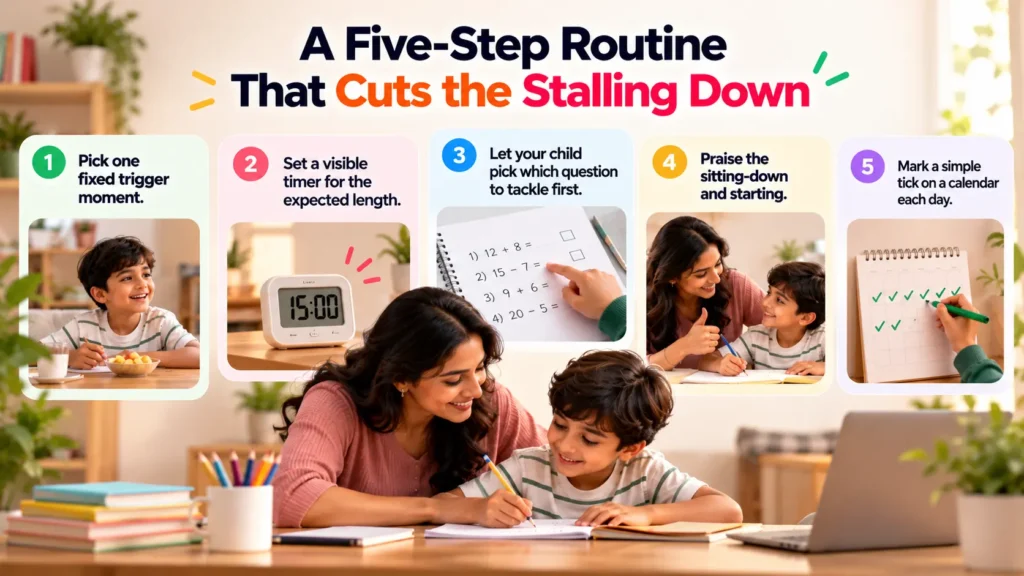
- Pick one fixed trigger moment, such as straight after an evening snack, so the worksheet is not something your child has to decide to start from scratch every day.
- Set a visible timer for the expected length rather than an open-ended “finish this.” Knowing the end point in advance removes a surprising amount of the resistance.
- Let your child pick which question to tackle first on the page. The worksheet content stays the same, but choosing the order gives a small, real sense of control.
- Praise the sitting-down and starting, separately from praising a correct answer. A child who stalls is usually more afraid of starting than of being wrong.
- Mark a simple tick on a kitchen calendar each day the worksheet starts within five minutes of the trigger moment, and let the streak itself become the small win.
Mental Maths & Vedic Maths drills run just a few minutes a day, which makes them a useful warm-up before the main worksheet on days when starting feels hardest.
When the Stalling Is Really About the Content, Not the Habit
Occasionally the issue is not avoidance at all. If your child starts promptly but then visibly struggles partway through the same type of question week after week, that is a difficulty mismatch rather than stalling, and the fix is different: step back to an easier grade’s worksheet on that one topic for a week rather than pushing through the same hard page daily. The two problems can look similar from across the room, so watch whether the trouble begins at the very first line (stalling) or partway through a specific question type (a level mismatch).
The Daily Maths Worksheets for Kids (Grade 1 to 12) subscription is organised with a separate syllabus for every grade, so moving a step up or down for a specific topic is a simple, reversible choice rather than switching products.
A Two-Week Plan to Build the New Habit
| Week | Focus | What You’re Watching For |
|---|---|---|
| Week 1, Days 1 to 3 | Fix the trigger moment and introduce the visible timer | Does the worksheet start within five minutes of the trigger, even if slowly? |
| Week 1, Days 4 to 5 | Add the choose-your-own-order step | Does your child engage with the page faster once they pick the starting question? |
| Week 2, Days 1 to 3 | Start the calendar tick for same-day starts | Is the streak building, or breaking on particular days (and if so, why)? |
| Week 2, Days 4 to 5 | Step back and observe without prompting | Does the child start the routine on their own, without being told? |
Two weeks is usually enough to tell whether the stalling is genuinely a habit issue that responds to structure, or something else worth a closer look, such as a specific topic that keeps tripping your child up.
Want a second pair of eyes on how week one went? Share your child’s grade and what you noticed with ComeOnKid on WhatsApp at +91 90255 08131 before starting week two.
Frequently Asked Questions
Bringing It Together
Stalling in front of a maths worksheet is rarely about maths. It is about an uncertain starting point, and once that starting point becomes fixed, timed, and partly in your child’s own control, the pencil-sharpening and water-bottle refilling tend to lose their appeal on their own. Try the five-step routine for the next two weeks before changing anything else about the worksheet itself.
Browse the Enrol page to see how daily worksheet practice fits alongside ComeOnKid’s other programmes.
Daily Maths Worksheets for Kids (Grade 1 to 12) is delivered on WhatsApp every weekday, with subscriptions starting at ₹499 a month. Message ComeOnKid on WhatsApp at +91 90255 08131 and tell us which of the four stalling reasons sounds most like your evenings, and we’ll suggest where to start.