


after diwali revision for kids, CBSE ICSE worksheets all subjects, daily practice during school vacation india, diwali vacation homework practice, festival break study plan for students, how to avoid losing study habit after holidays, keep child studying during diwali break, multi subject worksheets for kids india, premium worksheets KG to grade 12, whatsapp worksheets for kids india
Your child has probably already helped sort the diyas out of the storeroom and asked, for the fifth time, when the new clothes are arriving. Somewhere underneath that festive excitement, though, a quieter worry is forming in your head. School shuts for a few days around Diwali. No homework gets assigned. No one checks anything. And once the lights come down and the sweet boxes are empty, you are the one who finds out, usually the hard way, whether your child actually remembers what they learned before the break or whether the whole thing has to be rebuilt from scratch.
This is not really a question about whether Diwali should be a holiday. Of course it should. It is a question about what happens to five or six subjects worth of learning when nobody is actively keeping an eye on them for a week, and whether there is a way to protect that progress without turning a festival into another school day. That is exactly the gap Premium Worksheets for Grades KG-12 was built to sit inside, and it is worth looking at honestly, including where it does not fully solve the problem on its own.
Why a Short Break Can Cost More Than a Week
Teachers have a name for what happens when a child stops touching a subject for several days in a row: the forgetting curve. The idea is simple and most parents have seen it without knowing the term for it. Skills that were not fully set in, chapter-wise Maths steps, a new Science concept introduced just before the holidays, a grammar rule the child half understood, fade fastest. Skills that were already strong and well-practiced tend to survive a short gap just fine. The danger with Diwali is not the five or six days off. It is that the break usually lands right in the middle of a unit, often just as a school has introduced something new and before it has been reinforced through enough practice.
Add in the fact that most households are genuinely busy during Diwali week itself, guests arriving, travel to native places, late nights, decorating, cooking, and the honest reality is that nobody is sitting down to do a full page of homework on Dhanteras evening, nor should they have to. The practical question most parents are actually asking is smaller and more reasonable than “how do I keep my child studying through Diwali.” It is closer to “how do I stop five minutes a day from becoming zero minutes a day for a week, so that the Monday after the break is not a disaster.”
What a Festival Week Actually Looks Like Inside a Child’s Routine
If you map out a typical Diwali week hour by hour, the pattern repeats across most Indian households. The first couple of days are shopping, cleaning, and preparation. The middle two or three days are the actual festival, visiting relatives, bursting crackers where allowed, eating more sweets than any other week of the year. The tail end is slower, a bit of a comedown, and this is usually the stretch where children are a little bored, a little restless, and more open to sitting still for ten minutes than anyone expects. That tail end is the real opportunity, not the peak festival days themselves.
Multi-subject products like Premium Worksheets for Grades KG-12 are useful here precisely because they do not ask for a block of time. The subscription delivers a new worksheet from the student’s own grade syllabus on WhatsApp on school weekdays, covering Maths, Science, English, Hindi, Social Studies and more depending on the grade, each one chapter-wise so it maps to what the child is actually studying in class rather than a generic revision sheet. During an actual holiday week, no new sheet needs to appear for the child to still benefit. A parent can simply have the child redo the last two or three worksheets already received, five to ten minutes each, on the slower days of the break, which keeps the habit alive without adding new content pressure during the busiest days.
The Real Question Isn’t Whether to Study. It’s How Much, and in What Order
Turning Diwali into an extra school week is the wrong goal, and most parents instinctively know this. The more useful goal is protecting the subjects where a gap actually hurts, without pretending the other subjects need equal attention during a five-day break. Maths usually needs the most protection because its topics build directly on each other, a missed concept this week makes next week’s concept harder to follow. English and Hindi reading and writing skills are more forgiving over a short break, since they are built from years of repetition rather than one chapter. Science sits in between, depending on whether the class recently moved into a new topic. Social Studies is the most forgiving of all over a one-week gap.
That ranking suggests a simple approach for the holiday stretch rather than a rigid timetable: if there is only time for one worksheet a day, make it Maths more often than not, let English or Hindi fill in on the quieter afternoons, and treat Science and Social Studies as optional bonus rounds rather than daily obligations. This is a long way from spreading five subjects evenly across seven festival days, which is where most well-intentioned holiday study plans quietly collapse by day three.
A Grade-by-Grade Look, Without Overcomplicating It
Younger children in KG through Grade 2 do not need Diwali-week worksheets at all in the traditional sense. For this age group, the better use of ten minutes is reading a worksheet’s picture-based questions aloud together, naming shapes, colors, and simple words, which keeps early literacy and number sense warm without feeling like homework during a week that should feel festive and fun for a small child.
Grades 3 to 5 are where a short daily worksheet starts to genuinely help, because this is the age where Maths concepts like fractions, measurement, and multi-step word problems are being introduced for the first time, and a five or six day gap right after a new concept is taught is exactly when it slips. A single Maths worksheet redone from earlier in the week, done slowly with a parent nearby, is usually enough.
Grades 6 to 8 are juggling more subjects with more weight each, and this is the group most likely to actually ask for a worksheet themselves if the habit is already in place, since skipping it for a week can mean walking back into class feeling behind their friends who kept up. Grades 9 and 10 are closer to board-exam pressure depending on the term, and a short daily touch, even just reviewing one worked example, matters more here than it did a year earlier. Grades 11 and 12 students usually self-manage their own study time by this stage, and the worksheet’s role shifts from “keeping a habit alive” to “one more structured practice set among several,” which is still useful but no longer the main thing holding their preparation together.
Current price for Premium Worksheets for Grades KG-12 is ₹499 a month, listed on the product page as discounted from ₹999. If you want to see exactly what a worksheet for your child’s grade actually looks like before committing to anything over the festival season, message us on WhatsApp at +91 90255 08131 and ask for a sample from your child’s grade.
Want to see a worksheet for your child’s grade before committing to anything? Message ComeOnKid on WhatsApp at +91 90255 08131 and ask for a sample from your child’s grade.
What Most Families Try Instead, and Why It Often Doesn’t Stick
Three common fallback plans show up again and again when parents think about festival-week study. The first is simply doing nothing and hoping a week off makes no real difference, which is often fine for an already strong student in an easy phase of the syllabus, and genuinely risky for a student who was already struggling before the break started. The second is downloading random worksheets off the internet, which usually fail on relevance, since they rarely match the exact chapter a child’s own school is covering that term, so the child ends up practicing something they already know well or something they have not reached yet. The third is booking extra tuition sessions specifically over the holidays, which solves the structure problem but tends to feel, to a tired child during a festival week, exactly like more school at a time they were told was a break.
A chapter-wise, grade-matched worksheet sent over WhatsApp sits in a different spot from all three. It is specific enough to be useful, short enough that five or ten minutes genuinely covers it, and flexible enough that a parent decides which day in the week it gets used rather than a tutor’s calendar deciding for them. It is not a replacement for a child’s own motivation, and a worksheet nobody opens helps nobody, but it removes the planning burden that usually kills holiday study habits by the second day.
Reading This After Diwali Has Already Happened?
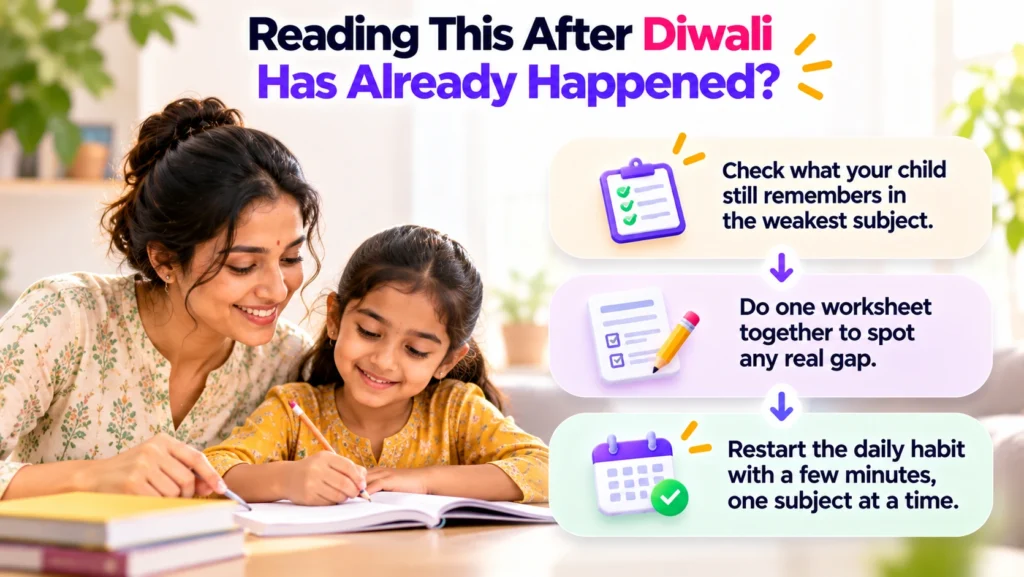
If you are catching up on this after the festival has passed and the break is already behind you, the advice does not really change, it just shifts into recovery mode. Spend the first school-week evening finding out, honestly and without panic, what your child actually remembers from before the break in their weakest subject. A single worksheet from that subject, done together rather than handed over and checked later, usually tells you within ten minutes whether there is a real gap or just rust that clears after one try. From there, the daily habit restarts exactly the way it would have during the break itself, a few minutes, one subject at a time, building back toward whatever rhythm existed before the holiday interrupted it.
Keeping This Realistic for Your Own Household
None of this works if it becomes one more thing to feel guilty about during a week meant for celebration. The honest goal is a floor, not a ceiling: even on the busiest festival day, five minutes of one worksheet, done without a fight, protects more than most parents expect. On the quieter tail-end days of the break, that can stretch to two subjects without anyone complaining much. If a particular day is simply too full of guests and travel for any of it, skipping that day and resuming the next is completely fine and does not undo the previous days’ work. The habit matters more than the streak.
Premium Worksheets for Grades KG-12 is built around this kind of flexibility already, since it is a WhatsApp subscription rather than a fixed class, covering Maths, Science, English, Hindi, Social Studies and more depending on grade, aligned to CBSE, ICSE, IGCSE and State Board syllabi, and set up chapter-wise so a parent is never guessing which topic to pick. If this is the first time you are hearing about it and want to check whether it matches your child’s current school syllabus before Diwali week starts, see the full Premium Worksheets plan details and compare it against what your child is currently studying.
Where This Fits Alongside the Rest of a Child’s Learning
Premium Worksheets covers the full spread of school subjects, but Maths in particular benefits from extra calculation-speed practice beyond what a chapter-wise worksheet alone provides, especially for a child who finds timed sums slow even when the method is correct. For families specifically looking to strengthen that side of Maths, Daily Maths Worksheets for Kids is a dedicated option worth comparing alongside the multi-subject plan. And if your family is weighing a subscription like this against ComeOnKid’s wider range of worksheet and activity products before deciding what fits your child’s grade and budget, the full ComeOnKid shop lists everything currently available side by side.
One more small thing worth saying honestly: a worksheet subscription, however good, is still just paper and practice. It works best alongside a parent who glances over it occasionally, not one who disappears entirely and expects a WhatsApp message to raise a child’s grades on its own. The families who get the most out of Premium Worksheets over a break like Diwali are usually the ones who treat the ten minutes as a small shared moment, not a task handed off and forgotten.
Frequently Asked Questions
The Bottom Line Before the Lights Go Up
Diwali is supposed to be a break, not a battle, and nothing here is asking you to turn a festival into an extra school term. The honest, modest goal is simple: a few protected minutes a day, mostly concentrated on whichever subject actually builds on itself week to week, so that the Monday after the break is a normal Monday rather than a catch-up crisis. Premium Worksheets for Grades KG-12 happens to fit neatly into that kind of light-touch routine, since it is already built around short, chapter-specific worksheets rather than long assignments, but the underlying habit matters more than any single product.
If you would rather just talk it through than read another paragraph, reach out through ComeOnKid’s enrollment page and a member of the team can walk you through which grade’s worksheets would suit your child before the holidays begin.
Want to confirm which plan fits your child? Send ComeOnKid a message on WhatsApp at +91 90255 08131 with your child’s grade and board, and someone will confirm which Premium Worksheets plan fits before Diwali week starts.