

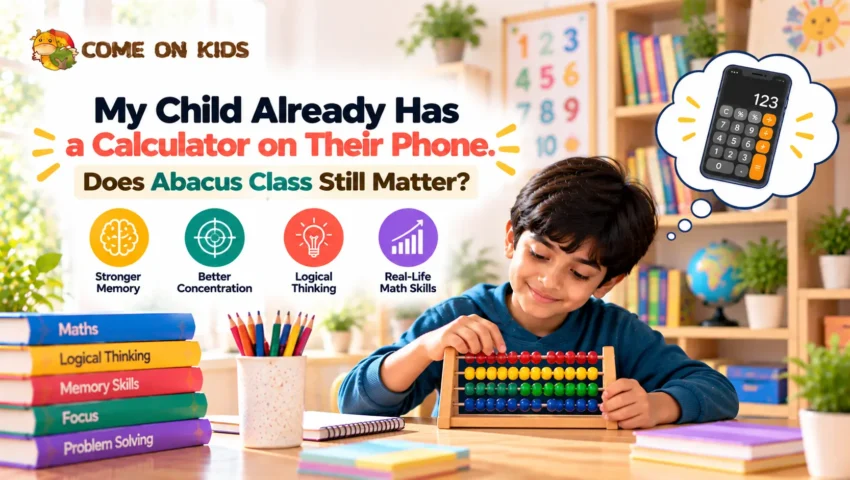
A parent recently asked a fair question: if a calculator app is sitting on every phone and tablet in the house, why spend evenings driving a child to an abacus class to learn how to add and subtract? It is a reasonable thing to wonder, especially when the class, the practice time, and the fees all compete with an already packed after-school schedule. The honest answer is that abacus training was never really about getting the right answer to a sum. It is about what happens inside a child’s head while they are getting there, and a calculator cannot do that part for them.
What Abacus Training Really Builds (It Is Not About Calculation)
A calculator solves a problem instantly and the child’s brain does almost no work in between. Abacus training does the opposite. In the early stages, a child moves physical beads to represent numbers, which builds a strong visual and tactile sense of place value. As they progress, they are trained to picture that same bead frame in their mind and “see” the calculation without touching anything, a skill usually called mental abacus or anzan. That shift from physical beads to a mental image is what builds working memory, visualization, and sustained concentration, skills a calculator has no role in developing at all.
The real comparison here is not abacus against calculator as two ways to land on an answer. It is deliberate mental effort against instant automation, two very different experiences for a growing brain. One builds a muscle. The other skips the workout.
Calculator vs Abacus: What Each One Actually Gives a Child
| What Parents Often Compare | A Calculator App | Abacus Training (ComeOnKid) |
|---|---|---|
| Speed of getting an answer | Instant, no effort required | Builds speed gradually through mental practice |
| Working memory and concentration | Not exercised at all | Directly trained through visualization drills |
| Understanding of place value and number sense | Hidden behind the screen | Built from the ground up with physical beads first |
| Usefulness in exams without devices | Not available | Fully available, since the “calculator” is the child’s own mind |
| Confidence and presentation skills | No social or spoken component | Practiced through small-group classes and skill demonstrations |
None of this means calculators are bad. They are genuinely useful tools for checking work or handling large real-world numbers. The concern parents are usually circling is dependence: a child reaching for a device for every small sum, including ones they are developmentally ready to do in their head. Abacus training is one of the more structured ways to build that mental capability before the habit of reaching for a screen sets in.
What Actually Happens Inside an Abacus Classroom at ComeOnKid
At ComeOnKid, Abacus Class is open to children aged 5 to 15, taught in small, personalized, level-based groups across both centres. Training progresses in stages, starting with physical bead calculation and moving toward mental visualization as the child advances through levels. Recommended home practice is just 5 to 10 minutes a day, short enough to fit around homework, play, and other activities rather than compete with them.
Parents often notice benefits that go well beyond arithmetic: stronger concentration, improved listening skills, better analytical and problem-solving ability, a sharper working memory sometimes described as a “photographic memory” for numbers, and more confidence when a child has to present or explain their thinking out loud. These are the kinds of gains that show up in schoolwork generally, not just in the maths notebook.
Curious whether your child’s age and current maths level are a good fit for Abacus Class? Message ComeOnKid on WhatsApp at +91 90255 08131 and a teacher will help you figure out the right starting level.
How Abacus and Mental Maths Practice Reinforce Each Other
Abacus is one path to building strong mental calculation, but it is not the only daily touchpoint a family can use. Short, consistent practice outside class time is what actually locks the skill in, whether that practice comes from the abacus frame itself or from a focused worksheet drill covering the same mental-maths muscle: Vedic maths shortcuts, speed calculation, and number sense. Explore ComeOnKid’s Mental Maths and Vedic Maths worksheets for that kind of practice.
For children who are not yet enrolled in a formal Abacus Class, or who want extra practice on the days between classes, a short daily worksheet habit covering general maths skills can keep the same calculation confidence building steadily at home. See ComeOnKid’s Daily Maths Worksheets for Kids (Grade 1 to 12).
Age-Wise: What to Expect as a Child Progresses
| Stage | Typical Age Range | What the Child Is Learning |
|---|---|---|
| Foundation | 5 to 7 years | Physical bead manipulation, number recognition, place value basics |
| Building Speed | 7 to 10 years | Faster bead calculation, early visualization exercises, simple mental sums |
| Mental Abacus | 10 to 13 years | Calculating by picturing the bead frame mentally, longer sums without touching beads |
| Advanced Practice | 13 to 15 years | Harder sums done in the head, quick-fire practice rounds, and the same sharp focus carrying over into other subjects |
Every child moves through these stages at their own pace, and ComeOnKid’s small, level-based classes are designed to let a child advance when they are ready rather than on a fixed timetable shared with the whole group.
When Calculator Dependence Actually Becomes a Problem
There is nothing wrong with a child using a calculator for genuinely large or complex numbers once they understand the underlying maths. The concern parents raise is usually more specific: a child who cannot estimate whether an answer looks roughly right, who freezes on a simple sum without a device nearby, or who has never built the quiet confidence of solving something entirely in their own head. Board exams, competitive exams, and most classroom tests do not allow calculators, which means mental calculation skill is not optional, it is something a child either has or has to build quickly under pressure later.
Starting that mental-maths foundation early, while it can still be built through play, small wins, and a structured class rather than exam-time pressure, is the real argument for abacus training, not nostalgia for a time before calculators existed.
Want to know which Abacus level would suit your child right now? Reach ComeOnKid on WhatsApp at +91 90255 08131 for a quick recommendation based on their age and current comfort with numbers.
Is Abacus the Right Fit for Every Child?
Abacus training tends to suit children who enjoy a bit of structure and repetition, and who are motivated by visible progress through levels. A child who already struggles with sitting still for focused practice may need a gentler introduction, shorter sessions, and a lot of encouragement in the first few weeks before the mental visualization stage starts to click. This is normal, and it is one of the reasons ComeOnKid keeps class sizes small, so a teacher can adjust pace to the child in front of them rather than a fixed syllabus.
Parents sometimes ask whether a child already doing well in school maths even needs abacus at all. The honest answer is that strong classroom maths and strong mental calculation speed are related but separate skills, and a child who is good at following steps on paper does not automatically have fast, confident mental arithmetic. Abacus builds the second skill directly, which is why many ComeOnKid families combine it with regular worksheet practice rather than treating the two as substitutes for each other.
Frequently Asked Questions
Bringing It Together
A calculator will always be faster at getting a single answer. What it cannot do is build the concentration, working memory, and quiet number confidence that stays with a child long after the phone is put away, in an exam hall, a classroom discussion, or simply figuring out change at a shop. That is the actual case for abacus training in a calculator-filled world, not that calculators are bad, but that some skills only grow through effort, not automation. Visit ComeOnKid’s Enrol page to see Abacus Class alongside other courses.
Want to see which Abacus batch and timing would work for your child? Message ComeOnKid on WhatsApp at +91 90255 08131 and the team will help you get started.